
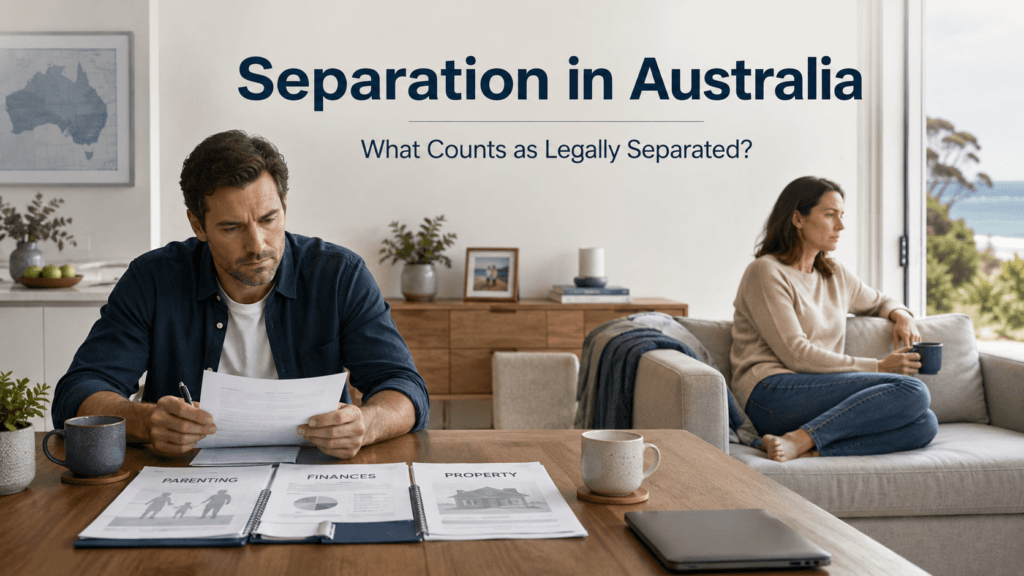
Separation in Australia does not always mean moving into a different home. A relationship can end even if both people still live together. What matters is whether the relationship has truly broken down and if one or both people want to end it. The date of separation matters because it can affect divorce applications, property issues, parenting arrangements, and government payments. Australian law allows married couples to be separated while living under the same roof, but the situation must show that the relationship has changed.
What Counts as Separation in Australia?
Separation starts when one person decides the relationship is over and acts on that decision. No specific form or certificate automatically ends a marriage. If you disagree about when separation happened, the court will look at the whole situation. They may consider factors such as no longer sharing a bedroom, separated finances, changed daily routines, informed family, or stopped presenting yourselves as a couple.
According to the Federal Circuit and Family Court of Australia, at least one spouse must view the marriage as finished. He or she must communicate this to the other spouse for divorce purposes.
Separation for De Facto Couples
Separation rules are not limited to married couples. De facto partners, including same-sex couples, also have rights and responsibilities when a relationship ends. The couple must show a genuine domestic relationship to make a financial or property claim. Relationships generally need to be at least 2 years old, although exceptions can apply when there is a child or one partner is significantly involved.
There is no marriage certificate for de facto couples, so proving separation can be harder.
When does Separation Legally Begin?
The separation date is when the relationship ends, not just when someone moves out. For example, one spouse may declare the marriage over on June 23, but remain together for months. Evidence of this date can include messages, financial changes, separate sleeping arrangements, or talking with the family. Having a clear separation date can help if there is a dispute later. Remember the date and keep evidence, especially if it affects a future divorce.
How Do You Prove Separation in Australia?
There is no universal checklist for separation. Evidence should show that the relationship has changed after the separation date. Financial arrangements are critical. For example, having separate bank accounts or stopping joint financial planning may support a separation claim. Household arrangements are crucial. Separate bedrooms, meals, and social activities can indicate the relationship has ended. In some cases, social evidence may be helpful. Family and friends might confirm that the couple has stopped living together. The court looks at the overall situation, not just one fact.
What Evidence Can Support Your Separation Date?
Useful records may include:
- Messages confirming the relationship has ended.
- Emails discussing the separation.
- Lease or accommodation records.
- Bank and financial documents.
- Changes to insurance or beneficiary arrangements.
- Records showing separate living arrangements.
- Evidence of separate social lives.
- Statements or affidavits from people who know about the separation.
All of these documents do not have to be collected by every separated couple. Evidence required will depend on the particular circumstances, particularly if one of the spouses disputes the date of separation. Maintaining a clear written record of important changes can reduce future uncertainty.
What Happens After Separation?
Separation can cause legal and practical problems together. Often, parents worry about where their children will live, their schools, and healthcare. You can work out your own arrangements or seek help through family dispute resolution if it is safe and practical. In Australia, family law requires parents to try this method before going to court before litigating child-related disputes.
Property and finances are separate from divorce. Separating couples may have to deal with finances, investments, businesses, debts, and superannuation. Make sure you get legal advice before signing financial agreements.
Spousal Maintenance
Spousal maintenance is financial support one partner pays to the other after separation. It is different from child support. Spousal maintenance might be available if one partner cannot support themselves and the other partner can. The court looks at age, health, income, ability to work, and child care. Maintenance can be paid regularly or lump sums. The parties can arrange it by agreement or court order.
Consent Orders and Binding Financial Agreements
The first step in resolving a conflict with your former partner is to reach an agreement. There are two ways to make your arrangement legally enforceable:
- Consent Orders: An agreement approved by the court in writing. Upon approval, they are legally binding and enforceable. They can cover property, finances, and parenting.
- Binding Financial Agreements (BFAs): A private agreement made without court. Both parties must receive independent legal advice before signing the BFA.
A casual agreement is not very protective if trouble arises later. Formalizing your agreement gives you both peace of mind.
Do You Need a Certificate of Separation?
There is no general Australian family law certificate that automatically proves a marriage has ended.
Australia has specific processes for people who are separated but still live under one roof. Its Relationship details – separated under one roof form (SS293) identifies whether an individual or couple should claim social security benefits.
Key Differences: Separation vs. Divorce in Australia
Separation and divorce are different legal events. Separation means that the relationship has ended. Divorce is the legal termination of a marriage.
| Aspect | Separation | Divorce |
| Legal Definition | Breakdown of a partnership when one or both partners decide to part ways. | The formal, legal termination of a marriage by a court order. |
| Who it applies to | Both married and de facto (including same-sex) couples. | Married couples only. |
| Is Court involvement needed? | No. There is no “legal separation register” or court process required to separate. | Yes. You must formally apply to the Federal Circuit and Family Court of Australia (FCFCOA). |
| Minimum Waiting Period | None. It begins the moment the relationship genuinely ends. | You must be separated for at least 12 months and 1 day before you can file an application. |
| Remarriage | You cannot remarry. Doing so before a formal divorce is legally considered bigamy. | A Divorce Order gives you legal freedom to remarry (usually finalised 1 month and 1 day after the hearing). |
| How to Prove It | Separate bank accounts, separate rooms, social media changes, or email/text notification changes. | By providing your Marriage Certificate, divorce application, and affidavits (if you separated under one roof). |
Couples can still meet this requirement while living together, but more proof may be needed.
What are The Steps to Divorce in Australia?
The usual process is:
- Confirm you have been separated for at least 12 months and 1 day.
- Check that you meet Australia’s eligibility requirements.
- Obtain your marriage certificate.
- Prepare the divorce application.
- Provide additional evidence if you lived under one roof while separated.
- File the application with the Federal Circuit and Family Court of Australia.
- Attend a hearing if required.
- Receive the divorce order when the divorce is finalised.
Applicants must meet certain eligibility requirements, including proof of citizenship, domicile, and residence. It is also necessary to provide information about the arrangements and welfare of children under 18 when making an application.
A divorce certificate Australia search is often referred to as proof of divorce. Divorces finalized after February 2010 can be accessed electronically through the Commonwealth Courts Portal.
FAQs
How to handle separating from a spouse?
Separating from a spouse is difficult emotionally and practically. Try to communicate clearly and respectfully, especially if you have children together. Organise your finances, know your rights, and arrange for parenting and property properly. You can reduce future conflicts by understanding your legal position.
Who gets to stay in the house during separation in Australia?
After separation, neither husband nor wife has to leave or stay at home. It depends on the situation and what both people agree on. Factors such as children, finances, safety, and living arrangements may affect who stays. Property rights do not expire when you move out.
What not to do after separation?
Make formal agreements after a separation, and do not assume everything will be resolved automatically. Think about the possible consequences before making a rash decision about property, money, or children. Getting the right advice and planning can prevent problems.
What should a wife not do during separation?
Wives should not hide finances during separation, make major decisions without advice, or sign agreements without understanding them. Also, avoid making decisions that could adversely affect parenting arrangements. It is important to keep records and handle matters carefully.
Should you get legal advice for separation?
A lawyer may be especially useful when the separation date is disputed or when significant debts or property are involved. It is also crucial if children are affected, a business or superannuation interests are involved, or safety concerns exist.
Final Words
Separation in Australia is about whether the relationship really ended, not just if one person left. A clear separation date matters for divorce later on. Even if you live together, you can still be separated, so it helps to keep evidence of how your relationship has changed. Remember, separation, divorce, property settlement, and parenting arrangements are different issues.
If your situation is complicated, it is wise to get legal advice before making decisions that could impact your property rights or parenting plans.