
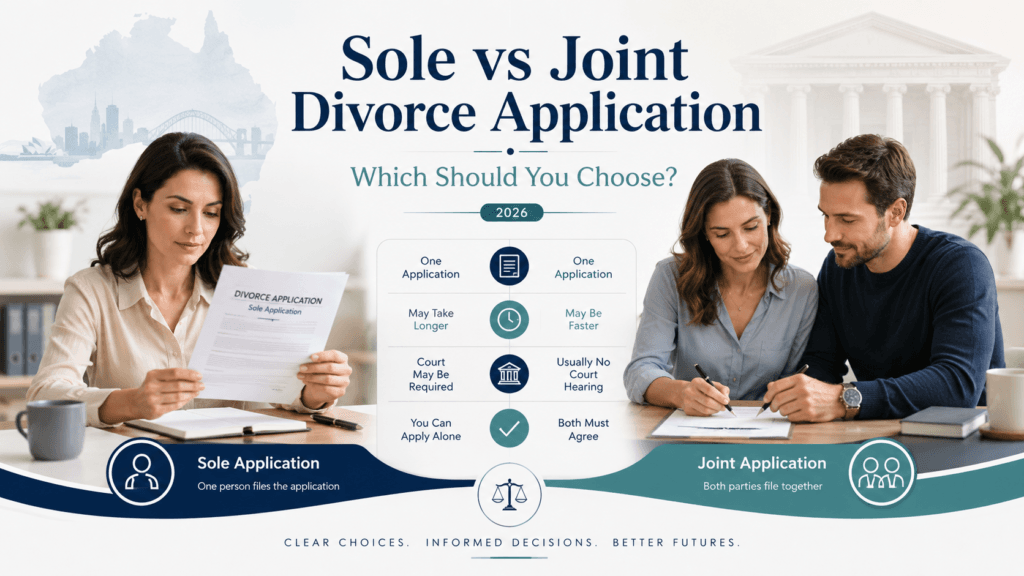
Ending a marriage involves more than just filling out a divorce form. Making a decision about submitting a sole vs joint divorce application may be your first step. Both spouses can apply for divorce individually in Australia, or both can apply together. Ultimately, both options lead to a divorce order, but their processes, responsibilities, and cooperation levels differ.
This guide explains the difference between a sole vs joint divorce application. Also, it gives you an idea of when each option might be appropriate, and what you should think about before you decide.
Important: This blog provides general information about sole vs joint divorce in Australia and is not a substitute for personalised legal advice.
What Is a Sole Divorce Application?
A sole divorce application is when one spouse files for divorce alone. The spouse who files is called the applicant, and the other spouse is the respondent. Only the applicant needs to sign the application. The respondent does not have to agree or sign anything. Since only one spouse is applying, the applicant must officially deliver the divorce papers to the respondent.
What Is a Joint Divorce Application?
A joint divorce application is filed by both spouses together. Instead of having one person as the applicant and the other as the respondent, both are considered joint applicants. Applicants can fill out the online application alone, but both must check it and sign the necessary documents. When both spouses are involved, divorce papers are usually not served formally on the other spouse.
Sole vs Joint Divorce Application: Quick Comparison
The main difference between the two is not the legal effect of divorce. It is mainly about how the application is made and what happens next.
| Issue | Sole Application | Joint Application |
| Who applies? | One spouse | Both spouses |
| Does the other spouse need to agree? | No | Yes, both participate |
| Who signs? | Applicant | Both applicants |
| Formal service required? | Generally yes | No |
| Cooperation required? | Limited | Higher |
| Suitable when communication is difficult? | Often yes | Usually not |
| Suitable for cooperative separations? | Yes, but joint may be simpler | Often |
| Divorce outcome different? | No | No |
When Might a Sole Divorce Application Be Better?
A sole application can be useful when your former spouse does not want to participate in the divorce process or when cooperation is difficult.
For example, a sole application may make more sense if:
- your spouse refuses to complete a joint application
- communication between you has broken down
- your spouse is delaying the divorce
- you prefer to manage the application independently
- you cannot reach agreement about completing the paperwork together
- contact with your former spouse is limited
Divorce in Australia is based on irretrievable breakdown of the marriage, not fault. By refusing to cooperate, a spouse cannot typically prevent a divorce. One spouse can start the divorce process without involving the other spouse.
What Happens If You Cannot Find Your Spouse?
Sole applications can become complex in this area. Orders for service may be necessary if you do not know where your spouse lives or cannot serve them.
Depending on the circumstances, this can include asking for:
- Substituted service: where the Court allows documents to be provided in another approved way.
- Dispensation of service: where the Court may remove the normal requirement for service.
Alternate service arrangements will be considered by the Court. Legal advice can be helpful if your spouse cannot be located.
When Might a Joint Divorce Application Be Better?
The joint application is especially useful when both spouses agree that the marriage is over and are willing to cooperate.
It may be suitable where:
- both spouses want the divorce
- communication remains respectful
- both are willing to provide the necessary information
- both are willing to sign the application
- neither person wants to arrange formal service
- both want a straightforward administrative process
The biggest advantage is that service is not required. Both spouses signed the application, so no proof of the delivery of divorce papers is needed for one spouse. This can reduce paperwork and remove a common source of delays.
What Requirements Apply to Both Types of Divorce Applications?
Regardless of whether you apply alone or jointly, you must still satisfy Australia’s legal requirements for divorce.
The Marriage Must Have Broken Down Irretrievably
Australian divorce is generally based on no fault divorce. The Court is primarily concerned with whether the marriage has broken down irretrievably rather than determining who was responsible for the relationship ending.
You Must Usually Be Separated for at Least 12 Months
Generally, spouses need to have been separated for at least 12 months before applying for divorce. It is possible to be considered separated while continuing to live under the same roof, although additional evidence may be required.
Australia Must Have Jurisdiction
At least one spouse must satisfy the relevant connection with Australia, such as citizenship, domicile or ordinarily living in Australia for the required period.
You Need Evidence of the Marriage
A marriage certificate is generally required as part of the divorce application. Additional requirements may apply where the marriage certificate is not in English or where other circumstances need explanation.
Common Mistakes to Avoid Problems
Divorce applications appear straightforward, but small errors can delay. The experts at AU Divorce can help you avoid these mistakes.
Common issues include:
- providing an incorrect separation date
- failing to correctly complete service
- serving documents too late
- attempting to personally serve your spouse
- missing signatures
- incorrectly witnessed documents
- failing to provide additional information about separation under one roof
- assuming divorce automatically resolves property matters
- assuming your spouse must agree before you can apply
Reviewing the application carefully before filing can reduce the risk of avoidable problems.
Is a Joint Divorce Cheaper Than a Sole Divorce?
Divorce applications, whether sole or joint, have the same filing fee. In 2026, the Federal Circuit and Family Court of Australia will charge $1,170 for divorces. There is also a lower filing fee of $390 for qualifying. There are different rules for sole and joint applications. For a sole application, only the applicant needs to meet the requirements. Joint applications need both applicants to qualify for the fee reduction. One person has to pay the whole fee if they qualify. Before filing, check the current fee schedule.
Can You Change From a Joint Application to a Sole Application?
The answer is yes, but you cannot simply edit a joint court filing that has been locked or submitted by another party. The joint application must be discontinued or withdrawn and the sole application must be filed to proceed.
Here are the Steps to Switching
- Withdraw or Discontinue: You may need to obtain leave of the court or discontinue the joint application if the joint application has already been filed with the Federal Circuit and Family Court of Australia.
- File a New Application: Log into the Commonwealth Portal, and select “Sole” rather than “Joint” under Part A.
- Handling Service Requirements: You have to serve the divorce papers legally to your ex if you are filing a sole application (as opposed than joint applications), which do not require delivery.
- Provide Proof of Service: Make sure your ex-spouse gets the documents by signing an Affidavit of Service.
Does It Matter Who Files for Divorce First?
Many couples do not get any significant legal advantage from being the first in line for divorce. No matter who files for divorce first, the court does not decide on property or parenting. A spouse who files first may have a practical advantage over a spouse who waits for the other to get started. The person making a sole application is also responsible for filling out the application and arranging services.
FAQs
Can my spouse stop me from getting divorced?
A spouse refusing to participate does not automatically prevent you from applying for divorce. You can potentially make a sole application as long as the relevant legal requirements are met.
Can we apply jointly if we disagree about property?
Potentially, yes. A joint divorce application concerns the legal dissolution of the marriage. Property settlement, parenting arrangements and other financial issues are separate matters.
Who pays the divorce filing fee in a joint application?
The spouses can decide between themselves who will pay or whether they will share the cost. The Court requires the applicable filing fee to be paid when the application is lodged unless an approved reduction applies.
Is a solicitor required to apply for divorce?
No. The Court allows people to prepare and file their own divorce applications, although legal assistance can be useful where circumstances are complicated.
What happens after the Court grants the divorce?
Once the divorce becomes final, the marriage is legally dissolved. Property, financial and parenting matters are not automatically resolved by the divorce order and may need to be dealt with separately.
Final Words
Choosing between a sole vs joint divorce application depends on how well you and your ex-spouse can cooperate. A joint application is easier when both parties agree, as it simplifies the process and avoids formal service. A sole application lets one spouse handle everything without the other’s signature, but it may require formal service and more steps. Both options are equally valid for getting a divorce. The best choice depends on your situation and helps keep the process moving smoothly. If there are issues like service difficulties, family violence, overseas parties, living together during separation, or disputes, consider getting personalized advice before filing.