
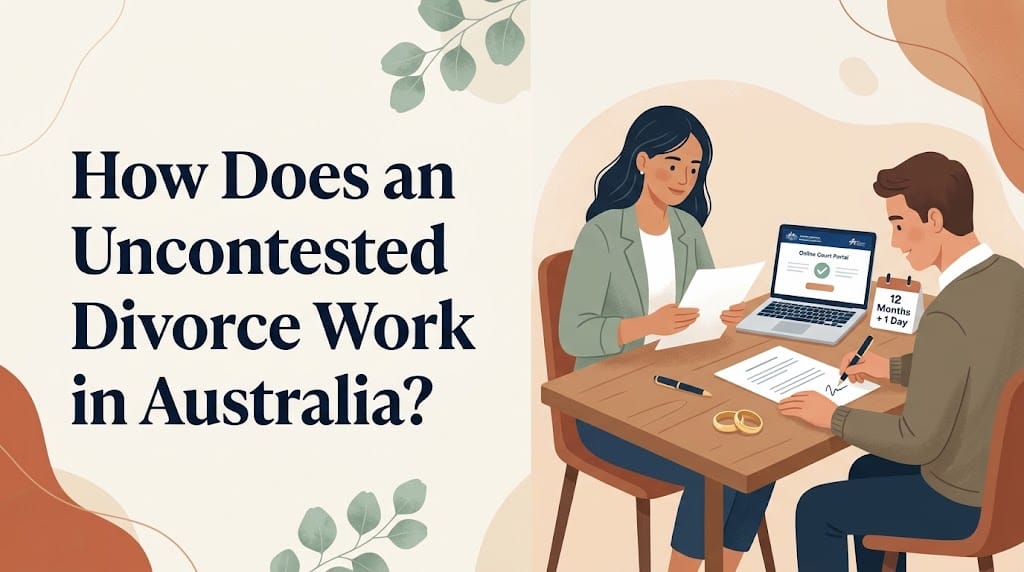
An uncontested divorce is a procedure in which both spouses agree on all matters and avoid a long, drawn-out legal battle. These issues usually involve property division, child custody, child support, spousal support, and debt allocation. The couples discuss arrangements together, typically with mediation or counsel. Rather than a court deciding. This procedure is usually faster, cheaper, and less stressful than a disputed divorce. Once negotiated, the settlement is submitted to the court for approval, ending the divorce quickly and amicably.
What Does Uncontested Divorce Mean in Australia?
The Australian Court rarely uses “uncontested divorce” to characterize a case. The Court focuses on joint and single divorce applications. Joint applications are usually the most official approach to divorce without a dispute. Partners submit the application simultaneously. Serving one spouse on the other is unnecessary if the application is for both. However, a single application can be uncontested. In this situation, one spouse could file and provide the other with the application. The divorce can proceed without opposition if the respondent does not oppose. So, “uncontested” usually alludes to conflict, not a divorce application type.
How Does an Uncontested Divorce Work in Australia?
The process begins by finding out if both spouses meet the legal prerequisites for divorce. The most significant need is typically the separation duration. Besides that, they have to show the Court that the marriage is finished and there is no chance of getting married again.
Step 1: Meet the Separation Requirement
You normally cannot apply immediately after separating. Australian law needs 12 months and 1 day of separation before filing for divorce. They can live together but remain separated. However, more proof may be needed to prove the connection ended.
Step 2: Choose a Joint or Sole Application
Both spouses may file jointly if they agree to collaborate. One spouse can complete the application and give it to the other spouse for review and signature. Both applicants must sign the necessary affidavit. In case only one spouse applies, it is a single application. The applicant must then serve the documents on the respondent.
Step 3: Complete and File the Application
Divorce applications should normally be submitted electronically using the Commonwealth Courts Portal. Applicants may prepare the application themselves or seek legal counsel. The Court considers the application and determines if the conditions have been met.
Step 4: Attend the Hearing if Required
Not everyone who wants a divorce needs to attend the meeting. When the parties file a joint motion, the Court may decide the case without them present. Sometimes attendance is still needed. For instance, a hearing may be needed if a party asks to be present or if the Court needs more information.
What Documents Do You Need for an Uncontested Divorce?
The exact documents depend on your circumstances.
Common documents and information include:
- Marriage certificate
- Divorce application
- Affidavit for eFiling Application
- Information about the separation date
- Details about children under 18, where applicable
- Additional affidavit evidence if the parties lived under one roof
- Supporting documents required because of particular circumstances
Both parties must sign the eFiling Application Affidavit for a combined application. Lawyers or Justices of the Peace must witness the signatures. The Court may request the overseas marriage certificate and other documentation. Before filing, it is advised to verify each document to prevent potential delays.
How Much Does an Uncontested Divorce Cost?
The Federal Circuit and Family Court of Australia charges $1,170 to file for divorce, with a $390 reduced cost for qualifying applicants. Before submitting, applicants should check the Court fee. Both parties must meet the qualifying conditions for a combined application to get a discounted fee. If just one joint application qualifies, the full cost may apply. Lawyers, document witnessing, service, and court filings may increase fees. Since service on the other spouse is not necessary, a combined application can decrease procedural effort. The level of expert assistance and the circumstances determine the final cost.
How Long Does an Uncontested Divorce Take?
The process has two important time components.
- First, the parties generally need to complete the required 12 months and 1day of separation before applying.
- Second, after the divorce order is made, it generally becomes final 1 month and 1 day later, unless the Court makes a different order.
The actual time between filing and the hearing can vary. Court availability, missing paperwork, extra evidence, and other factors might delay proceedings. Because both couples participate and you do not need to serve one spouse, a joint application may be simpler. The term “uncontested” does not guarantee an immediate divorce. The Court must review the application and ensure it is lawful.
Contested vs Uncontested Divorce
The main difference is whether the divorce is opposed.
| Contested Divorce | Uncontested Divorce |
| Divorce is opposed | Divorce is not opposed |
| Parties disagree about the application | Both parties generally cooperate |
| Often involves a sole application and response | May use a joint application |
| Service requirements can apply | No service required for a joint application |
| May require additional court involvement | Usually simpler procedurally |
| Court may need to consider disputed issues | Court still checks legal requirements |
A divorce decree does not automatically settle property distribution, financial support or parenting issues. Couples can get a divorce without a fight, but they may still need to make separate plans or court orders for their kids or funds.
Can You Apply for an Uncontested Divorce Online?
Australians often submit divorce applications online through the Commonwealth Courts Portal. Both single and joint divorce applications use the same online application. For a joint application, one spouse can fill out the first application. The other spouse reviews and signs it. Both parties must complete the necessary signing and witnessing procedures. The application is then submitted electronically with the required documents and filing fee. Online filing can streamline the administrative process, but applicants must still supply proper information. Incorrect separation dates, missing paperwork, or improperly attested affidavits can all cause complications.
Do You Need a Lawyer for an Uncontested Divorce?
You do not always need a lawyer for a divorce. The Court allows you to fill out your own divorce application. You can also hire a lawyer to help. A simple joint application works well for people who understand the requirements and have straightforward situations.
Legal advice can still be useful when:
- You have children under 18
- You lived together after separation
- Your spouse lives overseas
- Your marriage occurred overseas
- You are unsure about the separation date
- There are property or financial issues
- Your circumstances involve family violence or safety concerns
- You are unsure whether your application is complete
Importantly, getting a divorce does not resolve parenting or property issues. For certain matters, other legal actions could be required.
Common Mistakes to Avoid
Even an agreed divorce can experience delays when information is incomplete.
Common mistakes include:
- Applying before 12 months and 1 day has passed
- Entering an incorrect separation date
- Assuming agreement means Court requirements do not apply
- Failing to provide required information about children
- Using an incorrect or incomplete marriage certificate
- Failing to provide evidence about separation under one roof
- Incorrectly witnessing the affidavit
- Forgetting to pay the filing fee
- Assuming divorce automatically resolves property or financial matters
- Failing to check Court instructions after filing
The Court specifically states that an incorrectly witnessed affidavit may be rejected and need to be signed and witnessed again.
FAQs
Can I get divorced uncontested in Australia?
Yes. In Australia, you can apply for divorce on your own or together with your spouse. The only legal ground is that your marriage has broken down and you have been separated for at least 12 months. You can live under the same roof and still be “separated” if you no longer live as a couple.
Does uncontested mean we agree on everything?
Not always. It mostly means you both agree to the divorce itself. You don’t need to agree on everything else right away. Property and parenting matters can be sorted out separately, before or after the divorce is granted. Just note that if children under 18 are involved, the court must be satisfied they are properly cared for.
What if my spouse changes their mind?
In Australia, your spouse cannot stop a divorce just by changing their mind. If you have been separated for 12 months and the marriage has broken down, the court can still grant it. However, if you applied together and one of you withdrew, the other may need to file on their own. It’s also wise to talk openly first, as this often keeps things calm.
Does an uncontested divorce settle property?
Not at all. A divorce order does not decide how to divide property or handle money issues. Legal arrangements or court orders may need to be made separately.
Is an uncontested divorce cheaper?
Once both partners file jointly, the process may be easier. But you still have to pay the court filing fee. You may also have to pay more for skilled services or documents.
Conclusion
Uncontested Divorce – A friendly and sensible way to split from your spouse. Spouses can agree on such important matters, avoiding costly litigation and emotional pain and retaining control of the outcome. Uncontested divorces enable people to move on with dignity and respect, either through discussion or mediation. For some couples, a straightforward divorce may be the best option if they can talk things out and find common ground. You might want to talk with a family law professional to examine that possibility and make sure the arrangement is in your best interests.